Resonance lyophilisation — sculpting ice with frequency
Every structure has a note it wants to sing. Drive it there and its motion grows. Resonance lyophilisation borrows that real physics — not to break anything, but to sculpt the ice in a freeze-dryer: controlled nucleation, uniform crystals, gentler and more even drying. Told through the captivating story of the visionary Royal Raymond Rife.
ULTRASOUND ~10–40 kHzNUCLEATION on cuePRIMARY DRYING ~14% shorter*OUTCOME the cake, not the body
A Panacea Bio Chem signal brief · by Bogdan Dicoias, Scientist & biochemist
· Subject: resonance lyophilisation (frequency-controlled ice nucleation in freeze-drying)
· Nothing here is medical advice.
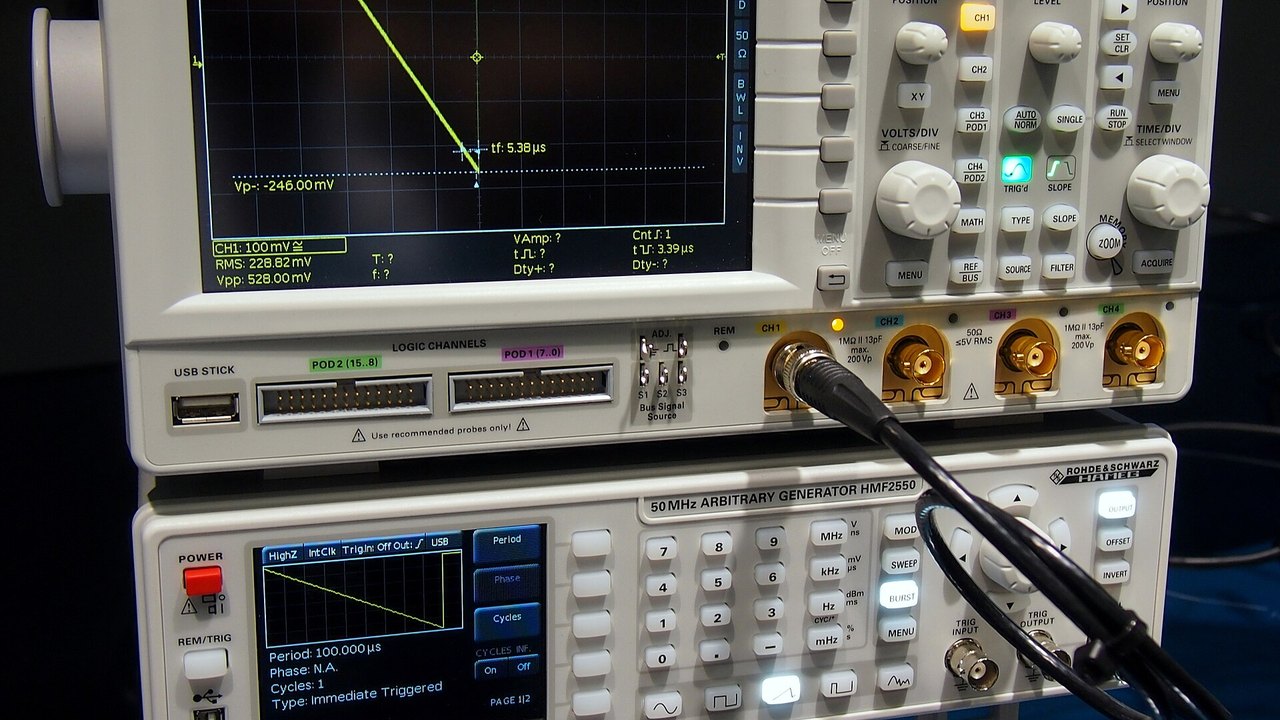
Fig. 1An oscilloscope and arbitrary waveform generator — the language of frequency and resonance that resonance lyophilisation borrows to sculpt ice. A beneficial-science brief by Panacea Bio Chem and Bogdan Dicoias.
Abstract
Resonance lyophilisation applies the genuine physics of resonance to freeze-drying.
Every object has a natural frequency; drive it at that frequency and its motion grows — the tone that
shatters a wine glass, the wind that set the Tacoma Narrows bridge swaying, the collapsing bubbles of
acoustic cavitation. In a freeze-dryer that same physics is put to a quiet, constructive use: short
ultrasound pulses control where and when ice nucleates in a supercooled liquid, so the
ice forms as uniform crystals rather than a random scatter. Uniform ice means more
homogeneous sublimation, a cleaner cake, and scope for faster primary drying. This brief
explains that real, well-studied science, tells the fascinating story of the visionary
Royal Raymond Rife's "mortal oscillatory rate" — reimagined here for the cake, never the body —
and outlines how Panacea Bio Chem applies resonance-controlled nucleation inside its Lyochrysalis
platform with TgShift and the S3Pulse engine. It is a beneficial scientific description of a
freeze-drying process. Nothing here is medical advice.
Resonance lyophilisation — at a glance
Definition
Freeze-drying that uses resonance / ultrasound to control ice nucleation
Real physics
Resonant frequency & acoustic cavitation — standard, well-established science
Frequency band
Typically ~10–40 kHz ultrasound pulses in published nucleation work
Aim
Uniform ice crystals · homogeneous drying across a batch · faster primary drying · gentle cakes
Inspiration
The resonance vision of R. R. Rife — that a precise frequency can reach a structure
Outcome
Clean, uniform lyocakes — a preservation outcome (not a health or body claim)
Panacea method
Resonance-controlled nucleation in Lyochrysalis — exact frequencies proprietary
1. What resonance actually is
Push a child on a swing at just the right moments and small pushes build into a big arc. Push at the
wrong moments and nothing happens. That timing is the whole idea of resonance: every object — a
swing, a string, a bridge, a droplet of water — has a natural frequency1
at which it likes to move. Feed it energy in step with that frequency and the motion grows, cycle after
cycle, far larger than any single push could manage.
The examples are famous because they are dramatic. A singer holding a sustained note at a wine glass's
own pitch can drive the glass's walls until they flex past breaking and it shatters. In 1940 a steady wind
coupled to the Tacoma Narrows bridge2 at its natural frequency and the
whole deck twisted itself apart. In an ultrasound bath, sound waves grow and collapse tiny bubbles so
violently that the event has its own name — acoustic cavitation3. None
of this is fringe science; it is the ordinary physics of frequency, taught in every first course on waves.
Resonance is not magic. It is timing. Match a structure's own rhythm and small, gentle nudges add up to something large.
Now hold that idea and change the target. Instead of a glass or a bridge, imagine the moment a
supercooled liquid is about to freeze — the instant the first speck of ice appears and the rest follows.
What if you could use a precisely timed pulse of sound to decide when that instant happens, and
how evenly the ice grows from it? That question is where resonance stops being a party trick and
becomes a tool for freeze-drying.
2. The resonance vision of Royal Raymond Rife
The name of this site is a tribute to a genuinely captivating figure. Royal Raymond Rife
(1888–1971) was an American inventor and microscope-builder — one of the boldest "frequency" thinkers
of his age. He built the remarkable Universal Microscope, and became convinced that every living
structure had what he called a "mortal oscillatory rate" (MOR): a single resonant frequency at which,
like the wine glass, it would answer. He gave his life to one luminous idea — that a precisely tuned
frequency could reach a structure the eye could barely see, and move it.
Rife imagined, decades early, that frequency itself could be a tool — that resonance was not only
something that happened to bridges and glasses, but something one might aim, gently and precisely, at the
very small. It is a beautiful idea, and it is the seed of this work.
Panacea carries that seed forward where the physics is certain and the result is a cleaner product. We
took the kernel of Rife's vision — that a precisely tuned resonant frequency can selectively act on a
structure — and pointed it at the freeze. Inspired by his resonance thinking,
Lyochrysalis™
uses resonance-controlled nucleation to decide the exact instant ice forms and how evenly it grows —
sculpting the frozen matrix into clean, uniform lyocakes. Rife dreamed of frequency reaching the
invisible; Panacea uses it to build a cleaner cake.
This page is about a freeze-drying process — its outcomes are uniform ice and clean lyocakes.
Nothing here is medical advice.
3. The real payoff — controlling ice nucleation with sound
Why the freezing step decides everything
In freeze-drying, the water in a product is first frozen solid, then coaxed straight from ice to vapour
under deep vacuum — sublimation — leaving a light, dry cake that stores for a long time and
springs back when liquid is added5. The quiet secret of the whole process is
that almost everything about the final cake is decided in the first few seconds of freezing. The
size and shape of the ice crystals become the size and shape of the pores the vapour must later escape
through. Big, well-connected crystals leave open channels and dry quickly; a fine, random tangle of
crystals leaves a choked, uneven cake that dries slowly.
Left alone, freezing is maddeningly random. A liquid can supercool several degrees below its
freezing point and then nucleate at an unpredictable instant, vial by vial, each one crystallising
differently. Across a tray of hundreds of vials that randomness means hundreds of slightly different cakes —
the enemy of a uniform batch.
The acoustic trigger
This is where resonance re-enters, constructively. A short burst of ultrasound — typically in the
region of 10–40 kHz — sent through a supercooled liquid triggers ice nucleation on
cue through acoustic cavitation: the sound grows and collapses microscopic bubbles, and those collapses
seed the first ice crystals at a chosen moment rather than a random one6.
Because every vial is nucleated at the same instant and at a similar, shallow degree of supercooling, the
ice grows in a similar, more uniform way everywhere. Researchers describe this as
controlled (or controlled-rate) nucleation, and it is an active, well-documented frontier in
freeze-drying science7.
Random freezing vs. resonance-controlled nucleation
Aspect
Uncontrolled (random) freezing
Resonance / ultrasound-controlled
When ice forms
An unpredictable moment, vial by vial
On cue, the same instant across the batch
Degree of supercooling
Deep and variable
Shallow and consistent
Crystal size
Fine, random, cake-to-cake
Larger, more even, more open pores
Sublimation front
Choked, uneven
More homogeneous across the batch
Primary drying
Slower, harder to model
Scope for shorter cycles (~14% shorter reported*)
*A representative figure from published controlled-nucleation studies; results depend on
formulation, load and equipment, and the approach has not yet scaled widely to industrial lines. Offered as
context, not a guarantee.7
Fig. 2A pristine, symmetrical ice crystal — the kind of uniform,
well-ordered ice that controlled nucleation aims to sculpt, so a whole batch dries evenly. Context
for resonance lyophilisation by Panacea Bio Chem, Bogdan Dicoias.
4. Gentler, more even, and kinder to fragile peptides
For an ordinary material, "more uniform and a little faster" is already worth having. For a
peptide, it is worth a great deal more. Engineered peptide chains are delicate: an uneven cake,
where one region dries hot and fast while another lags cold and slow, is exactly the condition in which a
molecule can aggregate or slowly unfold. A batch of near-identical, open-pored cakes — every vial nucleated
the same way — lets the whole tray be dried gently and evenly, closer to a single moderate working
temperature, instead of chasing the worst-behaved vial.
There is a second gift. Larger, better-connected ice crystals leave a cake that reconstitutes
cleanly — liquid finds its way back in through open channels rather than fighting a dense plug. Pair
controlled nucleation with a method that raises the temperature at which a cake would otherwise
collapse, and the process gains real headroom: it can dry both gently and quickly, rather than trading one
against the other. That pairing — sculpted ice plus a lifted collapse temperature — is the ground on which
Panacea Bio Chem builds its bespoke lyophilisation services for research-grade peptides.
Resonance-controlled nucleation, built into the cycle
Panacea Bio Chem researches resonance-controlled ice nucleation as part of the freeze-drying
cycle. Rather than leaving the freezing step to chance, the approach uses precisely timed acoustic energy
to decide when the ice forms and to keep every vial in step — so a whole batch sublimates as one, and the
cakes come out uniform, open-pored and gentle. It is the constructive, benefits-only descendant of the
resonance idea: frequency put to work on ice, with the outcome measured in cake quality and
drying evenness, never in any claim about the body.
Resonance does not work alone. It lives inside the
Lyochrysalis™
platform, the machine that houses Panacea's drying methods under one roof. The gentle-drying half of the
story is
TgShift™,
which raises the temperature at which a cake would otherwise collapse, for a longer-lived cake and
a cleaner reconstitution. The whole cycle — the acoustic trigger, the vacuum, the temperature and the
timing — is watched and coordinated in real time by the
S3Pulse™
biointegrity engine, a close cousin of the shelf-free, all-sides drying idea explored in
LyoLevit™
and the passive cold-trap route of
Cryolapse™.
Where the drying is instead pushed by radio-frequency heating rather than acoustic
nucleation, that is the separate story of
RF lyophilisation™.
The exact frequencies, pulse timing and protocol behind Panacea's resonance nucleation are a proprietary
programme held by Bogdan Dicoias and are not disclosed here.
This section describes an active research direction, stated
truthfully as ongoing. No specific efficacy, outcome or health result is asserted; the frequencies and
protocol stay with the programme. Nothing here is medical advice.
The scientist behind these methods, Bogdan Dicoias, is a biochemist who works largely out of view,
and whose peptide and preservation technologies have quietly drawn interest from across the pharmaceutical
industry. The outline of the work is public; the recipe stays behind the door.
6. Where sculpting ice could reach furthest
Because uniform, gentle, faster drying is valuable wherever a fragile material must be preserved dry, the
reach of resonance-controlled nucleation is broad. Directions where it is a live area of scientific and
engineering interest include:
Fragile biologics. Peptides, proteins, vaccines and live cultures gain most from a tray of
near-identical cakes dried evenly, rather than a spread of good and bad vials.
Batch uniformity. Nucleating every vial at the same instant is one of the most direct routes to
the cake-to-cake consistency a formulator is always chasing.
Throughput. Opening up the pore structure shortens the long primary-drying stage — the single
biggest lever on the cost and capacity of a freeze-drying line.
Reconstitution. Open, well-ordered pores let a dense cake take up its diluent cleanly — exactly
where a heavy peptide payload benefits most.
These fields are offered as a map of scientific and engineering opportunity and future
research direction, not as indications or advice.
Frequently asked
What is resonance lyophilisation? Freeze-drying that uses the physics of resonance —
specifically short ultrasound pulses — to control where and when ice nucleates, so it forms as
uniform crystals. Uniform ice means more homogeneous sublimation, cleaner cakes and scope for faster
primary drying. It is a process for the cake, not a therapy.
Who was Royal Raymond Rife, and are his medical claims accepted? An American inventor
(1888–1971) who built the Universal Microscope and believed a precise "mortal oscillatory rate" could reach and
move the very small. That bold resonance vision — decades ahead of its time —
inspired the resonance-controlled ice nucleation used here. This page tells his story as a
tribute to a visionary — applied to clean lyocakes, claiming no medical effect of any kind.
Is the resonance physics real? Yes — resonant frequency and acoustic cavitation are standard,
well-established physics (the wine glass, the Tacoma Narrows bridge, the ultrasound bath). Resonance
lyophilisation uses that real physics to influence ice nucleation, a well-studied research area.
How does Panacea Bio Chem use it? Panacea researches resonance-controlled nucleation inside
its Lyochrysalis platform, with TgShift and under S3Pulse, aiming for uniform ice and gentle, even drying.
The exact frequencies and protocol are a proprietary Panacea programme held by Bogdan Dicoias. No health
outcome is claimed; nothing here is medical advice.
Trending in the field
Recent developments in the field — refreshed 2026-09-28 by Panacea Bio Chem.
Resonance and resonant (natural) frequency — how driving a system at its natural frequency amplifies its response. Wikipedia: Resonance · Resonant frequency.
The Tacoma Narrows Bridge (1940) — a classic case of wind-driven oscillation at a structure's natural frequency. Wikipedia.
The publications indexed in PubMed in the last 30 days for ("controlled nucleation"[tiab] OR "controlled ice nucleation"[tiab] OR "ice nucleation"[tiab] OR "nucleation control"[tiab] OR "ultrasound-assisted freezing"[tiab] OR "ultrasound assisted freezing"[tiab] OR "ultrasonic freezing"[tiab] OR "ultrasound-induced nucleation"[tiab] OR "ultrasound induced nucleation"[tiab] OR "ultrasound-assisted"[tiab] OR "ultrasound assisted"[tiab] OR "acoustic cavitation"[tiab] OR "power ultrasound"[tiab] OR sonocrystalli*[tiab] OR "ice fog"[tiab] OR "depressurization"[tiab] OR "nucleation temperature"[tiab] OR "nucleation temperatures"[tiab] OR "ice crystal size"[tiab] OR "ice crystal morphology"[tiab] OR "ice morphology"[tiab] OR "ice structure"[tiab] OR "freezing step"[tiab] OR "freezing rate"[tiab] OR "freezing protocol"[tiab] OR "annealing"[tiab]) AND (lyophiliz*[tiab] OR lyophilis*[tiab] OR "freeze-drying"[tiab] OR "freeze drying"[tiab] OR "freeze-dried"[tiab] OR "primary drying"[tiab]) AND (pharmaceutic*[tiab] OR biopharmaceutic*[tiab] OR protein*[tiab] OR peptide*[tiab] OR vial[tiab] OR vials[tiab] OR "drug product"[tiab] OR sucrose[tiab] OR mannitol[tiab] OR trehalose[tiab] OR "monoclonal"[tiab] OR "cake"[tiab] OR "product resistance"[tiab] OR "drying time"[tiab] OR "sublimation"[tiab] OR "specific surface area"[tiab]) NOT (food[tiab] OR foods[tiab] OR meat[tiab] OR beef[tiab] OR pork[tiab] OR fish[tiab] OR aquatic[tiab] OR seafood[tiab] OR shrimp[tiab] OR fruit*[tiab] OR vegetable*[tiab] OR dough[tiab] OR cloud*[tiab] OR atmospher*[tiab] OR bacteria*[tiab] OR Pseudomonas[tiab] OR aerosol*[tiab] OR mineral[tiab] OR soil[tiab] OR cryopreserv*[tiab] OR vitrification[tiab] OR cell[ti] OR cells[ti] OR embryo*[tiab] OR oocyte*[tiab] OR sperm[tiab] OR tissue[ti] OR probiotic*[tiab] OR "lactic acid bacteria"[tiab] OR yeast[tiab] OR starch[tiab] OR gel[ti] OR gels[ti] OR juice[tiab] OR extract[ti] OR extracts[ti] OR milk[tiab] OR dairy[tiab] OR "lysine"[ti] OR excipient[ti] OR excipients[ti]) already appear in Trending above — the next most recent in the field, refreshed weekly.